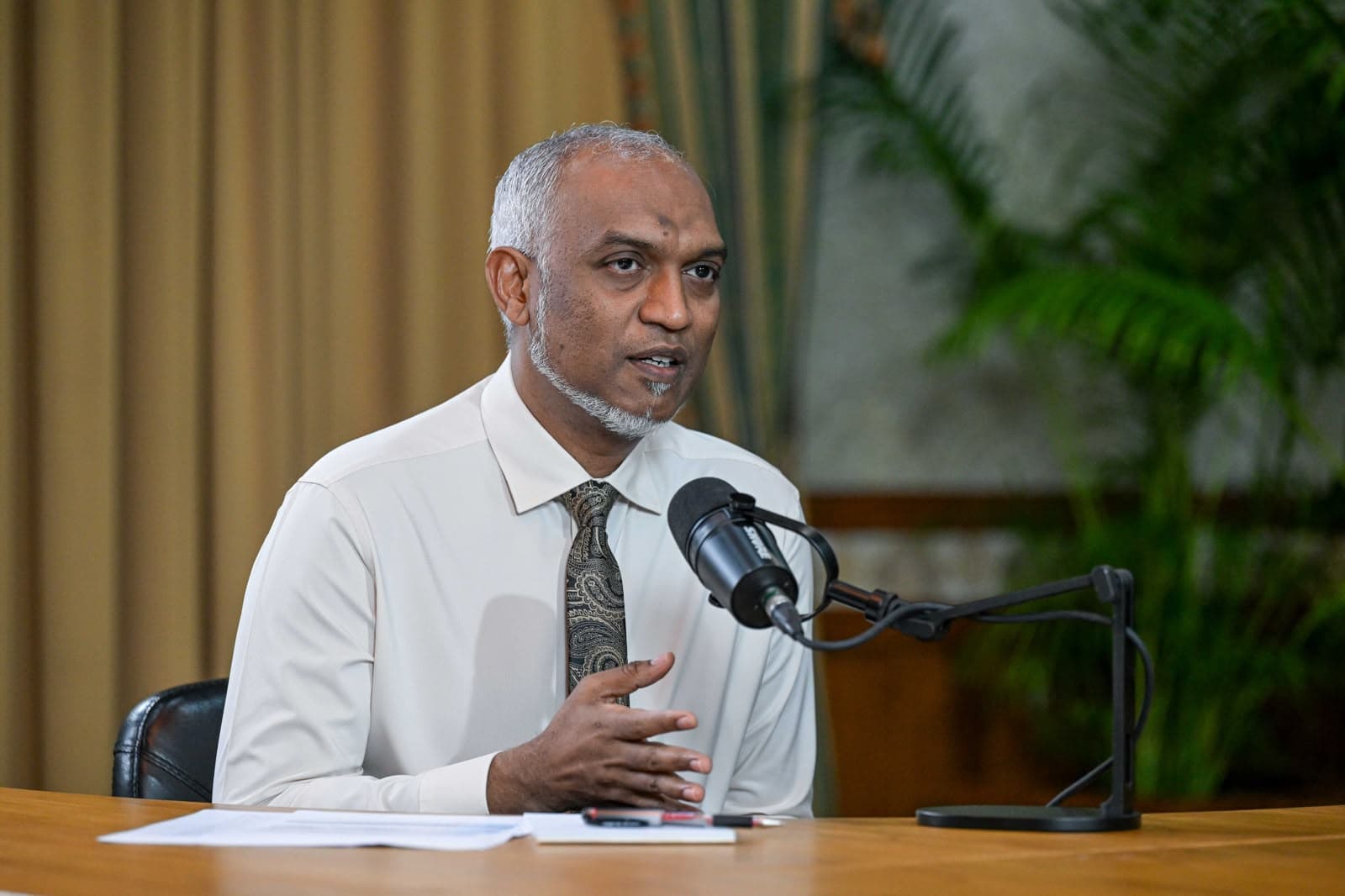
Vice President Hussain Mohamed Latheef has called for stronger protection of the sovereignty and decision-making rights of small states, while urging greater international action on Palestine, climate change, global finance and reform
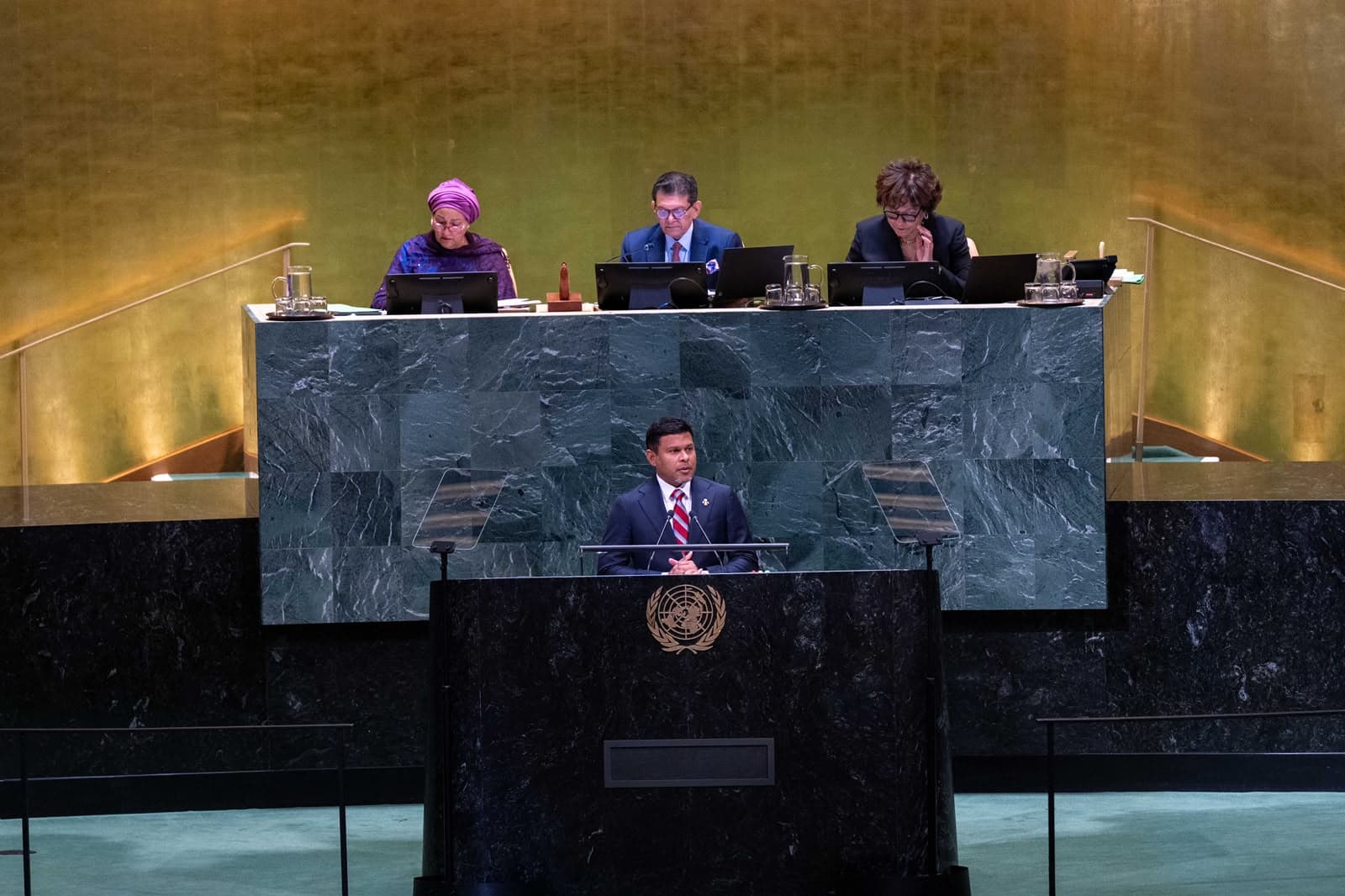
Vice President Hussain Mohamed Latheef has called for stronger protection of the sovereignty and decision-making rights of small states, while urging greater international action on Palestine, climate change, global finance and reform of the United Nations.
Addressing the General Debate of the 81st Session of the United Nations General Assembly (UNGA 81), Vice President Latheef said the Maldives’ central message was that every state, regardless of its size, should have the freedom and capacity to determine its own future.
He began his address by congratulating the President of the 81st Session of the General Assembly on his election and assuring him of the Maldives’ support. He also thanked former General Assembly President Annalena Baerbock for her leadership during the 80th Session.
Referring to this year’s theme, “Restoring trust, managing transformation: A United Nations that delivers for all,” Vice President Latheef said trust in the United Nations would not be restored through words alone, but through what the Organization delivers for countries “large or small.”
Maldives highlights evolving threats to small states
Vice President Latheef recalled that 37 years ago, the Maldives had raised concerns at the United Nations over the vulnerability of small states to external threats and acts of influence.
He said threats to sovereignty had evolved, with insecurity now extending through sea lanes, supply chains, financial markets, digital networks and emerging technologies.
“Today, sovereignty can be weakened without a single border being crossed,” he said, arguing that a state’s sovereignty could also be undermined when external powers restrict its freedom to make independent choices.
Against this backdrop, he said the Maldives was calling for every state to have “the freedom and capacity to shape its own future.”
Calls for peaceful Indian Ocean
The Vice President stressed that the Indian Ocean must remain peaceful and continue to provide an environment where trade can flow and countries can prosper.
He said competition among major powers should not restrict the choices available to smaller states, noting that conflicts far from the Maldives can have direct consequences for the country because of its dependence on international trade, tourism and maritime connectivity.
He cited disruptions to maritime traffic through the Strait of Hormuz as an example, saying such disruptions can increase fuel prices and affect food supplies, air travel, tourism and public finances in the Maldives.
The Maldives, he said, condemns the closure of the Strait of Hormuz and called for the waterway to remain open and safe.
Vice President Latheef also condemned attacks on Saudi Arabia, the United Arab Emirates, Bahrain, Qatar, Kuwait, Oman and Jordan.
He expressed appreciation for diplomatic efforts by Oman, Pakistan and Qatar aimed at de-escalating the crisis and bringing the parties to dialogue.
Maldives reiterates support for Palestine
A major part of the address focused on the situation in Palestine.
Vice President Latheef said the right to a sovereign future was being denied most severely to the Palestinian people, and accused Israel of continuing what he described as genocide and war crimes against Palestinians.
He also criticised Israeli military actions in other parts of the region, saying that such actions violate the sovereignty of other states.
“Security cannot be built by exporting insecurity,” he said.
The Vice President argued that international law must be applied equally to all states and that no country should be protected from accountability because of its political power or alliances.
He called for an end to the war in Gaza, the Israeli occupation of Palestine and other Arab lands, and illegal settlements.
He also called for humanitarian assistance to reach Palestinians safely, rapidly and at sufficient scale, while urging states to respect and implement the decisions of international courts and resolutions of the United Nations.
For Palestinians, he said, a sovereign future means freedom, dignity, self-determination and the right to live securely in their own state.
The Maldives, he reaffirmed, supports the establishment and international recognition of an independent and sovereign State of Palestine based on the pre-1967 borders, with East Jerusalem as its capital.
He further called for Palestine to become a full member of the United Nations.
Climate change described as a sovereignty and security issue
Turning to climate change, Vice President Latheef said the issue represents one of the most consequential threats facing Small Island Developing States (SIDS), including the Maldives.
He said rising sea levels are not merely an environmental concern for island nations, but also an issue of national planning, national security and sovereignty.
“Rising seas may alter our shores. But they will not erase our statehood,” he said, adding that climate change would not diminish the Maldives’ rights, maritime entitlements or national agency.
He called for greater access to climate finance, saying resources must reach vulnerable countries at the necessary scale, speed and on appropriate terms.
He also called on the upcoming COP31 in Antalya to focus on implementation and delivery, rather than commitments alone.
The Vice President urged countries to accelerate progress towards the 2030 Agenda and translate the Antigua and Barbuda Agenda for SIDS (ABAS) into measurable progress for small island states.
He also highlighted the importance of healthy and sustainably managed oceans and called for the first Conference of the Parties to the BBNJ Agreement to deliver tangible progress from its outset.
Maldives targets developed-country status by 2040
Vice President Latheef said the Maldives is pursuing President Dr Mohamed Muizzu’s ambition for the country to become a developed country by 2040.
He said the government is working towards this goal through measures aimed at increasing productivity, diversifying the economy, developing resilient infrastructure, expanding renewable energy and investing in human capital.
“Our future will be built by Maldivians,” he said, while noting that the international system can either expand or restrict the choices available to developing countries.
He identified technology transfer, resilient supply chains and accessible finance as factors that can expand national choices, while technological dependence, external shocks and unsustainable debt can constrain them.
Calls for reform of international financial system
The Vice President called for reform of the international financial architecture and urged countries to implement the Sevilla Commitment, particularly its commitments relating to finance, debt and reform.
He noted that the Maldives had joined other developing countries earlier this year in launching the Borrowers’ Platform.
He said the platform should become a lasting mechanism that gives developing countries a stronger voice in shaping the international financial system.
For SIDS, he said, greater national agency also requires stronger domestic institutions, stability, responsible investment and partnerships that build national capacity.
He stressed that international partnerships should respond to national priorities and leave countries with stronger capabilities.
Vice President Latheef described this approach as consistent with President Muizzu’s “Maldives First” policy, which he said is based on partnerships founded on respect for national interests and mutual contribution.
Maldives calls for inclusive AI governance
The Vice President also addressed the rapid development of artificial intelligence, saying AI presents significant opportunities for small states.
He said the technology could help countries overcome geographical and economic limitations and expand access to healthcare, education and public services.
However, he stressed that the benefits of AI should be shared broadly and that all countries should have a voice in establishing international rules governing the technology.
He said the digital transformation should strengthen countries’ ability to serve their people rather than create new forms of dependence.
UN reform must deliver results, Maldives says
Vice President Latheef welcomed the UN80 Initiative as an opportunity to reduce duplication, improve accountability and focus resources on results.
However, he cautioned that efficiency should not simply be measured by what the United Nations cuts, but by what it delivers.
He stressed that reform should not result in the United Nations withdrawing from countries that need its support, particularly SIDS.
The Vice President called for a meaningful UN presence on the ground and said reform of the UN Development System must remain responsive to programme countries and guided by relevant international frameworks.
He also said the reform process should be Member State-led, inclusive and transparent.
Maldives calls for Security Council expansion and abolition of veto
Vice President Latheef called for reform of the UN Security Council, arguing that its current composition does not adequately represent the modern international system.
He said the Council should be expanded in both permanent and non-permanent categories and called for SIDS to have a rotating seat.
He also called for greater representation for Africa and for the abolition of the veto.
“Representation is not merely symbolic,” he said. “Who sits at the table shapes what the table sees.”
He said small states understand the interconnectedness of climate change, finance, trade, supply chains and security, and stressed that international law remains their strongest safeguard against unequal power.
Maldives announces bids for UN bodies
Vice President Latheef highlighted the Maldives’ upcoming roles and candidacies within the UN system.
He said the Maldives will serve on the Economic and Social Council (ECOSOC) for the 2027–2029 term.
The country is also seeking election to the UN Human Rights Council for the 2028–2030 term and is seeking the support of member states for a seat on the UN Security Council for the 2033–2034 term.
He said these efforts are based on the principle that small states should be “decision-makers, not decision-takers.”
Calls for woman to become next UN Secretary-General
The Vice President thanked UN Secretary-General António Guterres for his leadership and commitment to international cooperation as he approaches the end of his tenure.
He said the selection process for the next Secretary-General should be transparent and merit-based and should draw on the full range of talent available within the United Nations.
Noting that every UN Secretary-General for more than eight decades has been a man, Vice President Latheef said it was time for a woman to lead the Organization.
He called for a leader who would uphold the UN Charter, turn reform into tangible delivery and listen to all member states, including the smallest.
Maldives proposes “sovereign future” test
Concluding his address, Vice President Latheef proposed what he described as a simple test for determining whether international action supports a sovereign future.
He said countries should ask whether decisions on conflict, climate, finance, technology and institutional reform expand a state’s freedom to choose, build national capacity and reduce dependence, and protect sovereignty and independent decision-making.
“If the answer is no, we must change course,” he said.
He said international cooperation should ultimately be measured not by what governments promise, but by what they make possible for their people and countries.
Vice President Latheef concluded by recalling the Maldives’ longstanding advocacy for the protection of small states and said the country was now calling for the international system to protect every state’s freedom to choose its own future.
“A future chosen by its people. A future grounded in international law. A sovereign future for every State,” he said.
How did this land?
Share this story
Discussion
Comments are turned off for now.