Bangladesh, Bhutan, Maldives and Nepal have signed a Memorandum of Intent MoI to facilitate the exchange of pre-arrival information on goods, marking a step towards faster and more coordinated customs procedures across
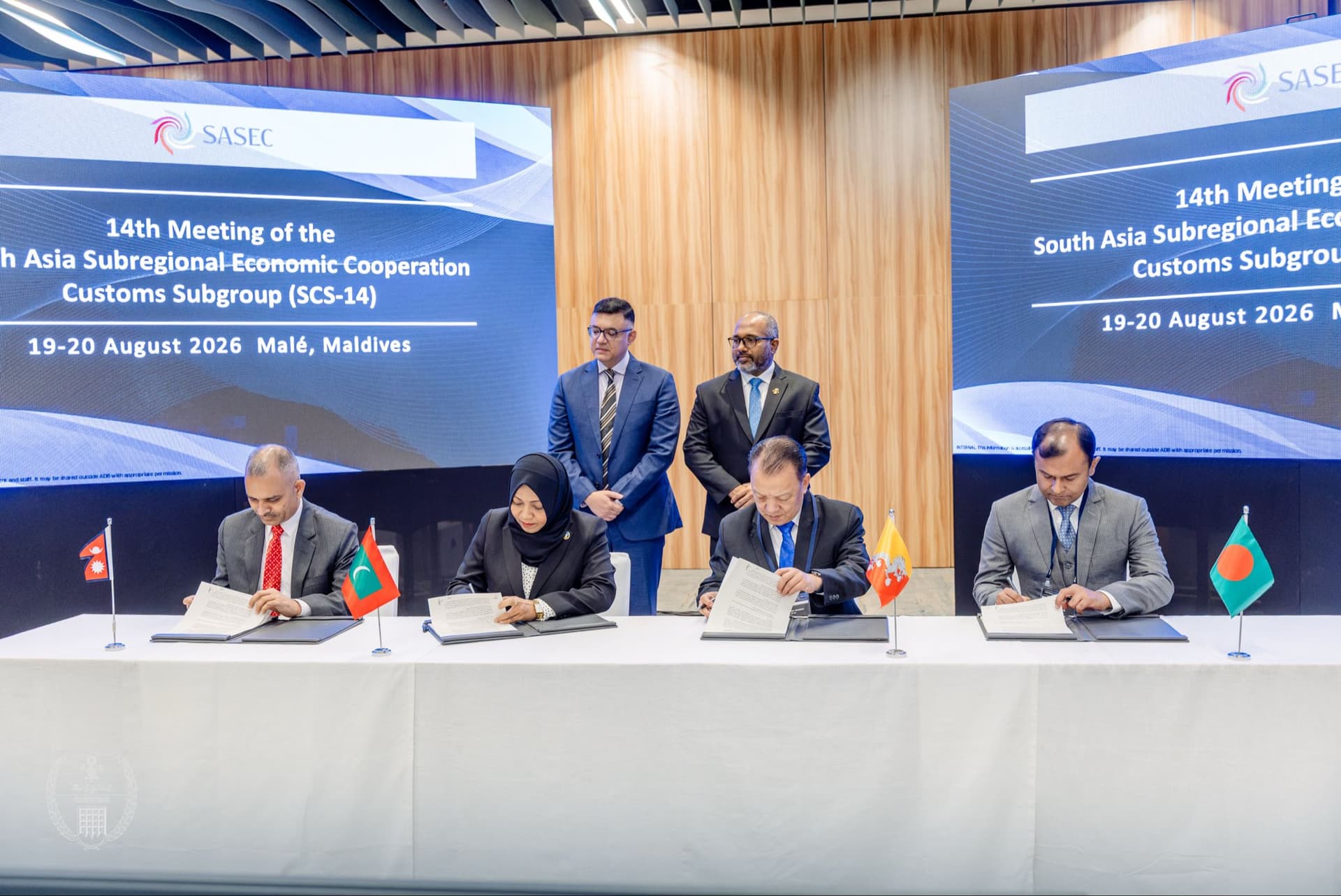
Bangladesh, Bhutan, Maldives and Nepal have signed a Memorandum of Intent (MoI) to facilitate the exchange of pre-arrival information on goods, marking a step towards faster and more coordinated customs procedures across the region.
The agreement was signed on 19 August 2026 in Malé during the 14th South Asia Subregional Economic Cooperation (SASEC) Customs Group meeting. The signing was witnessed by Minister of Homeland Security, Labor and Technology Ali Ihusaan and Asian Development Bank (ADB) Principal Regional Cooperation Specialist for South Asia, Dr. Yurendra Basnett.
Under the MoI, the four countries will cooperate in exchanging key cargo information before shipments arrive. Sharing such information in advance allows customs authorities to assess consignments and identify potential risks before goods reach the border or port.
The initiative is expected to strengthen customs controls while reducing delays in the clearance of legitimate shipments. It is also intended to improve coordination between customs administrations and support more predictable movement of goods across borders.
Pre-arrival information exchange is part of SASEC’s broader efforts to modernize customs procedures and facilitate regional trade. SASEC’s trade facilitation action plans have identified electronic exchange of pre-arrival data, coordinated border management and information sharing among customs authorities as key measures for improving cross-border trade.
SASEC, established as a project-based regional cooperation program, brings together Bangladesh, Bhutan, India, Maldives, Myanmar, Nepal and Sri Lanka to promote economic cooperation, connectivity and intraregional trade. The Maldives became a full member of SASEC in 2014.
The latest agreement builds on earlier efforts within SASEC to exchange customs information. The subregional program has previously supported the sharing of export-related documents between customs authorities at major border crossings, with the aim of improving risk assessment, compliance and the facilitation of legitimate trade.
For businesses, the new framework is expected to help reduce border and customs-related delays, lower logistics costs and make shipment timelines more predictable. It is also expected to strengthen supply-chain security by allowing customs administrations to identify and assess potential risks before cargo arrives.
The agreement is therefore expected to contribute to making cross-border trade among participating countries faster, safer and more reliable while strengthening cooperation between their customs authorities.
How did this land?
Share this story
Discussion
Comments are turned off for now.