President Dr. Mohamed Muizzu has ratified the first amendment to the Waste Management Act, introducing stronger requirements for waste management systems, clearer regulatory responsibilities and changes to the way plastic bag charges
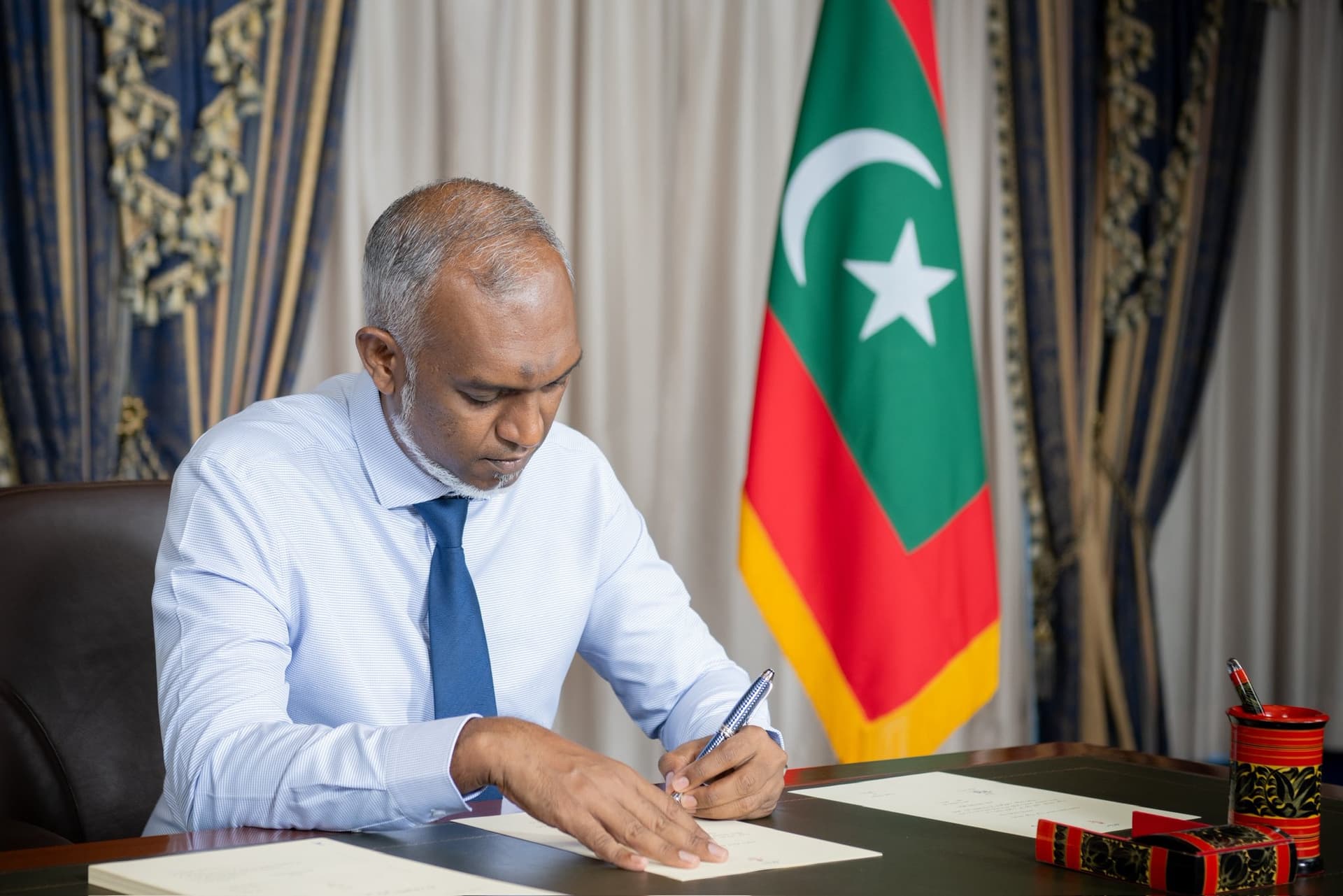
President Dr. Mohamed Muizzu has ratified the first amendment to the Waste Management Act, introducing stronger requirements for waste management systems, clearer regulatory responsibilities and changes to the way plastic bag charges are applied.
The amendment to the Waste Management Act (Act No. 24/2022) was passed by the People’s Majlis during the 25th sitting of its second session for 2026 on August 17. It came into force following presidential ratification and publication in the Government Gazette.
A key feature of the amendment is the establishment of clearer requirements for waste management infrastructure across the country. Islands and areas leased for economic or industrial activities will be required to have appropriate waste management systems, while the Utility Regulatory Authority will be responsible for verifying and monitoring compliance.
The amendment also provides for the transportation of waste generated outside the jurisdiction of an inhabited island to a designated waste management centre on an inhabited island. This is intended to strengthen the system for collecting and handling waste generated in areas that do not have their own established waste facilities.
Greater enforcement powers have also been introduced. The Environmental Regulatory Authority has been given the authority to formulate regulations allowing fines to be imposed on people whose waste management violations, contrary to requirements enforced by the Ministry of Climate Change, Environment and Energy, cause harm to the environment or public health.
The legislation further tightens controls on hazardous and imported waste. Following the amendment, importing waste into the Maldives will constitute a criminal offence. The sale, use or distribution of hazardous waste without a permit from the Environmental Regulatory Authority will likewise be punishable under the law.
The amendment also addresses the MVR 2 charge imposed on plastic bags.
Businesses will no longer be required to apply the MVR 2 charge to plastic bags sold or provided to customers at the point of sale. Packages containing more than 50 plastic bags are also exempted from the charge.
The change removes what the amendment identifies as a double-taxation issue that had arisen in transactions involving plastic bags, providing greater clarity for businesses and consumers.
The government has been pursuing broader efforts to improve waste management and develop more structured waste treatment and disposal systems. Waste Management Corporation Limited (WAMCO), for example, continues to operate waste collection and management services, while major projects are also being developed to expand environmental and waste infrastructure. Government-backed environmental projects include the Greater Malé Environmental Improvement and Waste Management Project and the Greater Malé Waste-to-Energy Project, which also targets inhabited islands in several atolls.
Under the newly amended law, regulations required to implement the changes must be drafted and published in the Government Gazette within 30 days of the Act coming into force.
The amendment therefore provides a strengthened legal framework covering waste infrastructure, regulatory oversight, environmental protection and offences, while also revising the treatment of plastic bag charges.
How did this land?
Share this story
Discussion
Comments are turned off for now.